
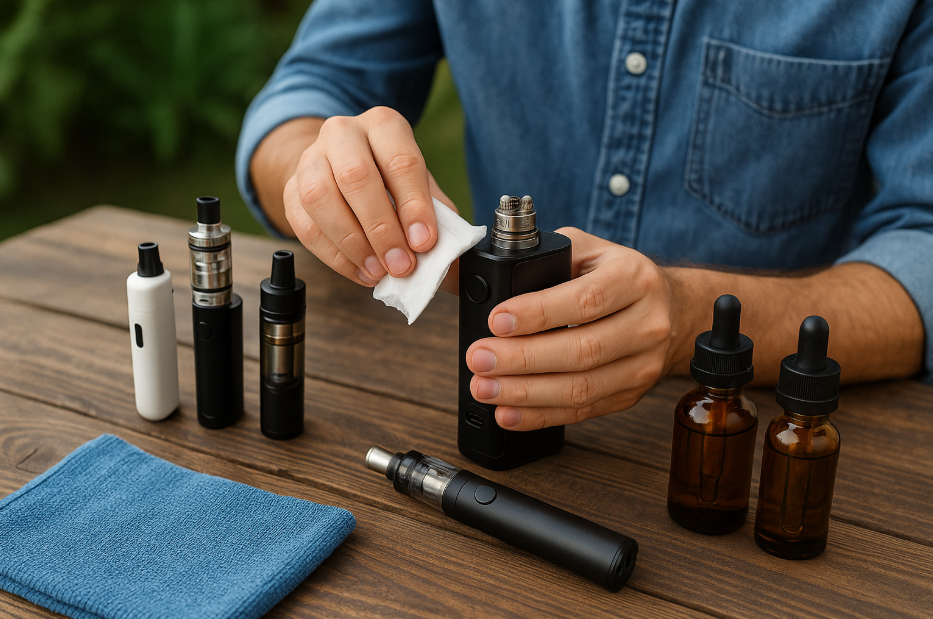
Every vape device that ‘suddenly stopped working’ has a history, and it is almost never a manufacturing mystery: it is a fortnight of lint in the airflow, a coil pushed past its life, a battery run flat daily, or a summer spent on a dashboard. Maintenance is the least glamorous chapter of vaping and comfortably the most profitable — the difference between a kit that performs like new for a year and one that limps to the bin in two months, between coils that last a fortnight and coils that die in days, between flavour that stays vivid and flavour that mysteriously went flat. This guide is the full servicing manual the box never included: daily habits, the weekly five-minute routine, coil and pod life extension, battery care, seasonal storage, deep cleaning, and the diagnostic playbook for every common fault. Guides on how to vape teach the inhale; this one keeps the machine worth inhaling from.
Know What You’re Maintaining
Maintenance differs by hardware tier, so orient first. Prefilled pod systems are the low-maintenance extreme: the pod carries liquid, coil and mouthpiece as one disposable unit, so upkeep reduces to device care — battery, contacts, storage — plus pod handling discipline. Refillable pod kits add liquid management and periodic pod or coil replacement to that list. Tank kits add the full curriculum: coil changes, tank cleaning, seal care, occasional rebuilding for the dedicated. The principles below cover all three, flagged where they diverge; prefilled users can skim the coil-change mechanics and pocket the rest, because the habits that kill devices — heat, lint, flat batteries, dry firing — are tier-agnostic.
The Golden Rule: Never Fire a Dry Wick
One rule outranks the rest because its damage is instant and permanent. Coils vaporise the liquid held in their wick; fire a wick with no liquid in it — a brand-new unprimed coil, an empty tank, a pod squeezed past its last drops — and the wick material scorches in a second, tainting every subsequent puff with burn. The protective habits: prime every new coil or pod (two to three minutes standing for prefilled pods, five to ten for freshly filled refillables, ideally with a manual drop of liquid on visible wick ports for tank coils); refill at a quarter-full rather than at empty; retire prefilled pods when flavour thins rather than chasing the final fraction; and pause during heavy chain sessions, which can outrun wicking even in a full tank — a hot, harshening puff is the wick asking for thirty seconds. Vapers who internalise this one rule report coil lifespans their forums refuse to believe.
What care habits are worth — typical coil/pod lifespan with and without the basics, from our testing.
Daily Habits: The Invisible Service
Good maintenance is mostly things you stop doing. Store the device upright where practical, especially overnight and with fresh pods, so liquid sits where wicks want it. Keep it off heat sources — dashboards, windowsills, radiator shelves — because warm liquid thins, seeps and gunks coils faster, and heat is separately unkind to batteries. Give it a clean pocket or a case rather than a life among keys and coins, which feed lint into airflow channels and grit into charging ports. Wipe the mouthpiece daily-ish for hygiene, and twist a corner of dry tissue into it whenever you hear condensation crackle beyond the normal. Cap or pocket the device rather than leaving airflow holes face-up collecting dust on a desk. Each habit costs seconds; together they eliminate the majority of gunk, leak and airflow complaints before they exist.
The Weekly Five Minutes
Once a week, a short structured check keeps everything ahead of failure. Exterior and contacts: wipe the device down; inspect the pod bay or 510 connection and clean any liquid or lint from the contacts with a dry cotton bud — dirty contacts are the top cause of weak or intermittent firing. Airflow: check inlets for lint and clear gently. Liquid audit: for refillables, top up and note the coil’s age; for prefilled, honestly assess flavour freshness. Battery audit: confirm charging behaviour is normal and the port is debris-free. Stock audit: one sealed spare of every consumable, with the reorder triggered when a spare gets opened, not when it runs out. Seals, for tank users: a quick look at o-rings when refilling — a pound of seal care prevents a pocketful of leaked liquid. Five minutes; and the 9pm emergencies this hobby is famous for simply stop happening.
Extending Coil and Pod Life
Coils and pods are the running cost, so their lifespan is your money. Beyond priming and the dry-fire rule, three factors dominate. Draw style: slow, gentle draws let the wick keep pace; hard fast pulls flood, spit and stress the coil — the gentle draw is simultaneously a technique, comfort and maintenance upgrade. Liquid choice: sweeter, darker liquids caramelise on coils dramatically faster — the gunk that kills flavour — so heavy-sweet fans should budget shorter coil lives, and anyone chasing longevity should note that lighter fruits and menthols run cleanest; ratio matters too, with thick high-VG juice starving small MTL wicks. Power discipline, for adjustable kits: running a coil above its rated range cooks it in days — stay mid-range. Under good habits, expect prefilled pods to deliver their full rated liquid, refillable coils one to two-plus weeks; the vapers getting three days were never unlucky, just unread.
Battery Care Without the Chemistry Lecture
Modern built-in lithium cells are robust, but four habits meaningfully stretch their healthy years. Charge opportunistically: partial top-ups are actively good for lithium, while routinely running to empty ages it — the while-cooking charge is ideal practice, not laziness. Avoid heat, again: a hot car degrades a cell faster than a year of normal cycling. Use sensible chargers: any standard USB-C lead, but a reputable mains adapter rather than an anonymous fast-brick pushing aggressive current. And respect damage: a device that gets unusually hot charging, swells, or smells wrong retires immediately — no heroics with lithium, ever. Separate-battery mod users add the classics: no loose batteries in pockets with keys or coins (a genuine fire risk), wraps intact or professionally rewrapped, and matched pairs kept together. Treated this way, a built-in cell comfortably outlives your interest in the device it powers.
Deep Cleaning and the Off-Season
A quarterly deep clean resets refillable hardware to near-new: disassemble what the manual permits, rinse tanks and pods (never coils — water ruins wicks) in warm water, dry completely for a day, clean threads and contacts with cotton buds and a drop of isopropyl alcohol on stubborn residue, and reassemble checking seals. Devices themselves never get rinsed — wiped only. For storage — a backup kit, a long trip, a step-down success story — prepare properly: tank emptied and cleaned (liquid left standing gunks and stains), battery stored around half-charged rather than full or flat (kindest to lithium over months), the whole kit boxed cool and dry, and liquids sealed in the dark, where unopened bottles and pods keep a year or more. A kit stored right revives in minutes; one stored full and flat on a sunny shelf is usually a write-off with extra steps.
The Diagnostic Playbook
When something does misbehave, the fault tree is short. No fire or weak fire: battery first (display, charge, port debris), then contacts (clean and reseat the pod — a not-quite-clicked pod is the single most common ‘broken’ device), then coil age. Burnt taste: dry wick history — new coil unprimed, tank run dry, or chain-vaping — and a properly scorched wick does not recover; replace and adopt the golden rule. Gurgling and spitback: flooding — draw slower, keep upright, clear the mouthpiece with tissue; persistent gurgling on a tank suggests seal or fill errors. Leaks: heat, overfilling past the line, worn seals, or a cracked pod — isolate by inspection in that order. Weak flavour with normal vapour: coil gunk (change it) or vaper’s fatigue (rotate flavours) — tell them apart by whether a fresh coil fixes it. Ninety-plus percent of forum complaints resolve inside this paragraph.
Stock the Cupboard Like a Pro
Maintenance runs on supplies, so close the loop with logistics. The standing inventory for a trouble-free vaper: one sealed spare of every consumable in current use, a spare USB-C lead living where you sit, cotton buds and tissue in the drawer, and — for refillable users — a spare coil pack ahead of need. Buy consumables in multi-buy bundles from an established UK specialist rather than singles from whoever is nearest: cheaper per unit, and genuine stock matters doubly for consumables since counterfeit coils and liquid are where corner-cutting bites hardest — check for UK-compliant labelling and strengths at or below 20mg as standard. pink vape carries the consumable ranges, spares and bundle pricing this system runs on, with guides alongside — a sensible single home for the reorder habit. A maintained kit with a stocked cupboard is a hobby with no emergencies left in it.
Maintenance FAQs
Quick answers to the questions this manual raises. How do I clean the inside of a pod bay properly? Dry cotton bud only, with the pod out — never liquids into a device. My coil is only three days old but tastes burnt — replace or persist? Replace; scorched wick does not heal, and diagnosing why (priming? ran dry? heavy sweet liquid?) is the real fix. Can I leave liquid in a tank for a week away? Better to run it low or empty it — standing liquid gunks coils and tests seals; sealed prefilled pods, by contrast, wait happily. Is it normal for the mouthpiece to get warm? Mild warmth during use, yes; heat at rest or while charging, no — retire that device. Do magnetic pods wear out their fit? Rarely; a suddenly loose pod usually means debris in the bay, cleared with the cotton-bud pass. How long should the actual device last? Treated by this guide, the battery is the clock — commonly a year and often well beyond of daily service — and most people replace kits out of curiosity long before necessity. And is any of this worth it for a cheap kit? Especially then: the habits are free, and they are the entire difference between cheap and disposable.
The Bottom Line
Vape maintenance compresses to a creed: never fire a dry wick, keep it charged, cool, upright and lint-free, draw gently, change coils when flavour says so, and hold one spare of everything. Perhaps twenty minutes a month, total, against which it returns longer-lived coils, a battery that ages gracefully, flavour that stays true, zero emergencies and a device that performs in month twelve as it did in week one — the best-paying twenty minutes in the hobby. The deeper point is what maintenance buys for switchers especially: reliability, and a habit whose infrastructure never hands you an excuse at a vulnerable moment. Adults 18 and over, as ever; look after the kit, and the kit looks after the switch.